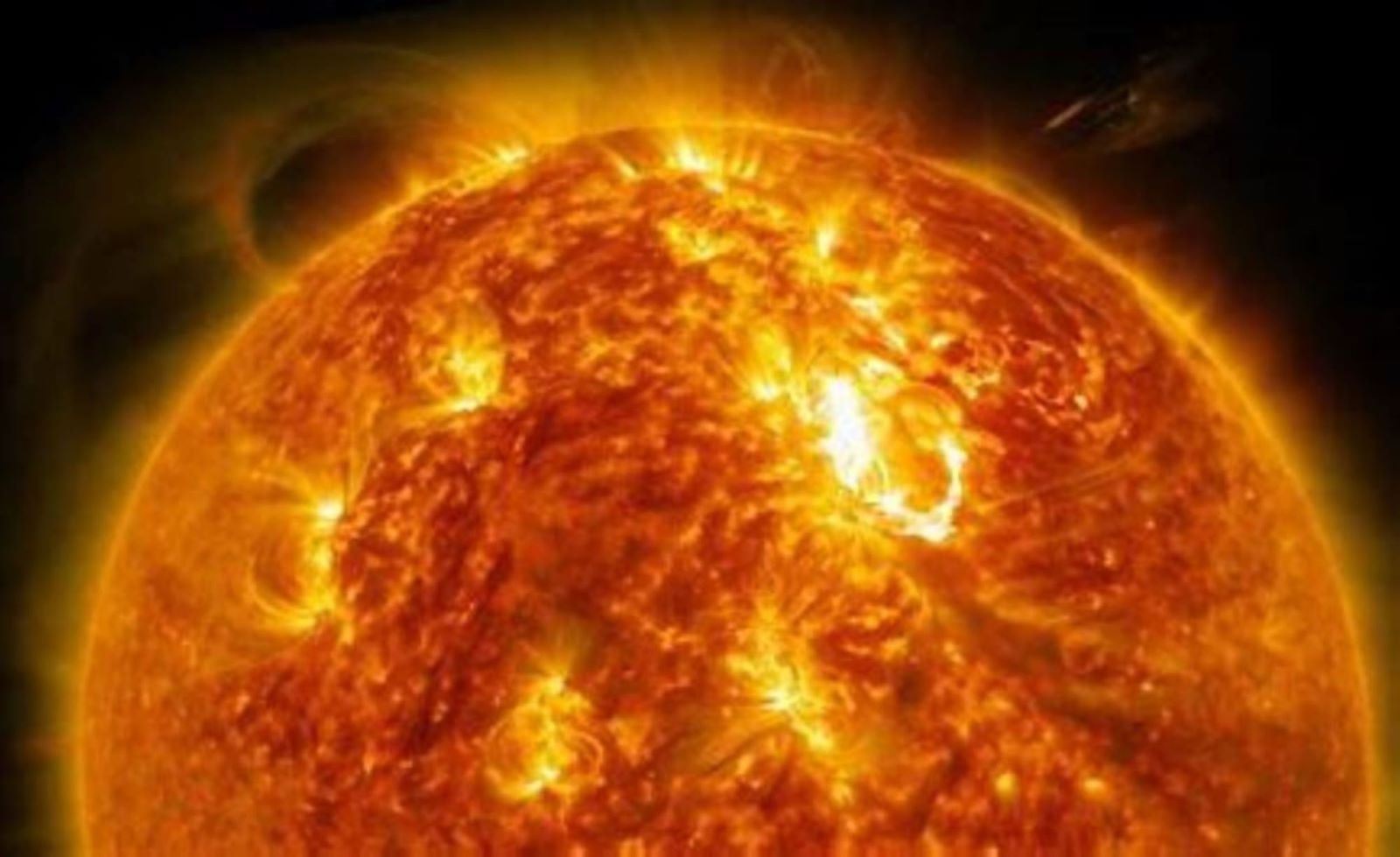
About the Sun
The Sun is a star at the center of our solar system, providing light, warmth, and energy essential for life on Earth. It is a massive ball of hot, glowing gases, primarily hydrogen and helium, undergoing nuclear fusion. This process releases an enormous amount of energy, which radiates outward, sustaining life on our planet and influencing the entire solar system. The Sun's gravity keeps the planets, including Earth, in orbit, and it has a profound effect on space weather, including solar winds and magnetic storms. As a middle-aged star, it has been shining for about 4.6 billion years and will continue to do so for several billion more before undergoing transformations that will eventually lead to its expansion into a red giant and later a white dwarf.

Classification:
The sun, one of the most well-known stars in our universe, is classified as a G-type main-sequence star, more commonly known as a yellow dwarf star. Yellow dwarf stars make up around 7% of stars in the Milky Way Galaxy. Other types include red giants, white dwarfs, binary stars and supergiants.
Red giants are old stars that have exhausted their hydrogen fuel and begun fusing heavier elements together. White dwarfs, on the other hand, are very hot in comparison but much smaller. Their diminutive size is due to a lack of mass resulting from the star's exhaustion of fuel.
Binary stars are pairs of stars orbiting each other while supergiants have extremely large masses and intense luminosities. The earth’s sun is a relatively medium-sized star with a stable temperature that’s ideal for life to flourish.
What is a Yellow Dwarf Star?:
A yellow dwarf star is a type of star classified as a G-type main-sequence star which is characterized by its moderate temperature and yellowish appearance. These stars typically have surface temperatures between 5,300 and 6,000 degrees Celsius (9,500 to 10,800 degrees Fahrenheit), which gives them their yellow hue, as opposed to hotter stars, which might appear blue, or cooler ones, which might appear red.
Yellow dwarfs are in a stable phase of their life cycle, known as the main sequence, where they primarily fuse hydrogen into helium in their cores. This process releases a huge amount of energy, which causes the star to shine brightly. Over the course of billions of years, yellow dwarfs like the Sun will gradually consume their hydrogen and evolve into red giants before eventually shedding their outer layers and becoming white dwarfs. Yellow dwarfs typically live for around 10 billion years, and the Sun is about halfway through this phase.
Did you find the information about the Sun useful? Contact us to see if we can help.